
The ability to translocate and integrate useful, resilient traits into a foodshed? A true power of the open-pollinated archetype. Besides, 'The Machine' breeds hybrid melons only for hot climates, not cool nights. So, we've claimed Haogen (early, Israeli) as a 'future heirloom.'
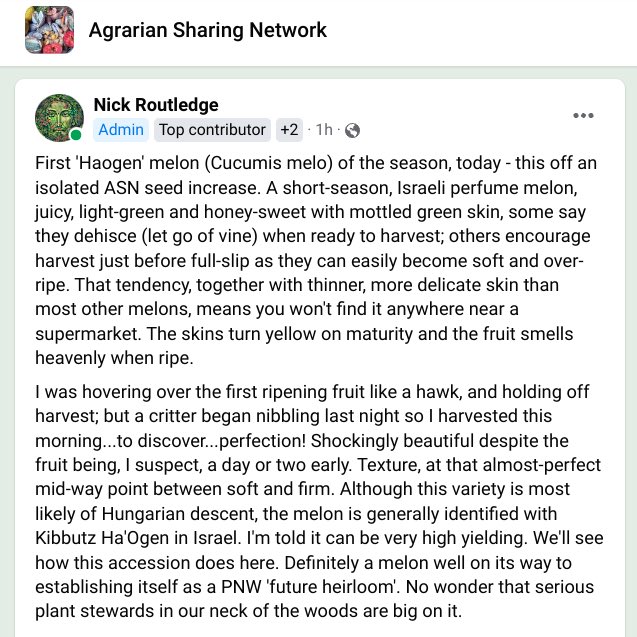
Image description
Original X alt text
Copy of ASN Facebook post, here: First 'Haogen' melon (Cucumis melo) of the season, today - this off an isolated ASN seed increase. A short-season, Israeli perfume melon, juicy, light-green and honey-sweet with mottled green skin, some say they dehisce (let go of vine) when ready to harvest; others encourage harvest just before full-slip as they can easily become soft and over-ripe. That tendency, together with thinner, more delicate skin than most other melons, means you won't find it anywhere near a supermarket. The skins turn yellow on maturity and the fruit smells heavenly when ripe. I was hovering over the first ripening fruit like a hawk, and holding off harvest; but a critter began nibbling last night so I harvested this morning...to discover...perfection! Shockingly beautiful despite the fruit being, Texture, at that almost-perfect mid-way point between soft and firm…
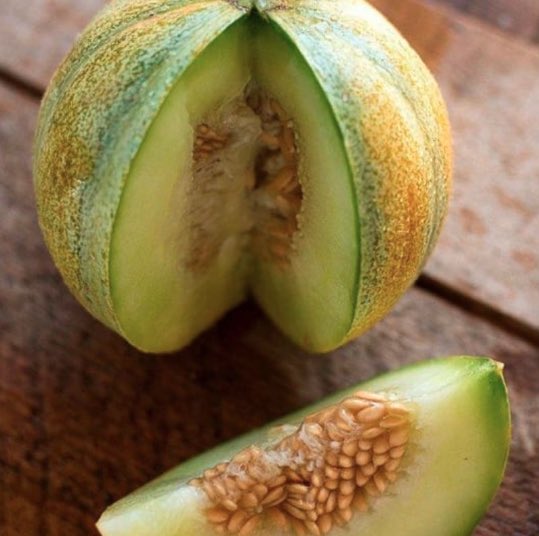
Image description
Original X alt text
A 'generic' photograph off the web of Haogen. I ate today's example before photographing it.
@MadsMcKeever 1/ Yup, they have that rep. I'm consistently struck by the truly planetary intelligence revealed in functional, regenerative homecoming, wholly at odds with facile, nationalist madness. We rely vitally on 'diversity composites' of material from Russia, Ukraine, Belarus, China...
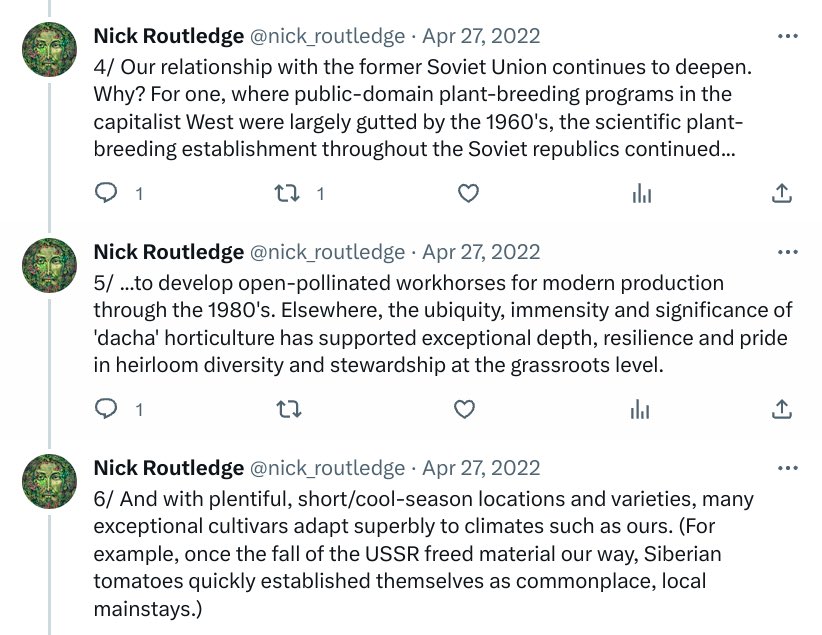
Image description
Original X alt text
Excerpt from tweet thread beginning here: 4/ Our relationship with the former Soviet Union continues to deepen. Why? For one, where public-domain plant-breeding programs in the capitalist West were largely gutted by the 1960's, the scientific plant-breeding establishment throughout the Soviet republics continued... 5/ ...to develop open-pollinated workhorses for modern production through the 1980's. Elsewhere, the ubiquity, immensity and significance of 'dacha' horticulture has supported exceptional depth, resilience and pride in heirloom diversity and stewardship at the grassroots level. 6/ And with plentiful, short/cool-season locations and varieties, many exceptional cultivars adapt superbly to climates such as ours. (For example, once the fall of the USSR freed material our way, Siberian tomatoes quickly established themselves as commonplace, local mainstays.)