
@GMWatch ?s=20
Making a killing. How's it going? "Despite major gaps in knowledge about the environmental, health and safety impacts, RNAi-based insecticidal sprays are already being field tested in the US." shorturl.at/boOT8 shorturl.at/tGI56
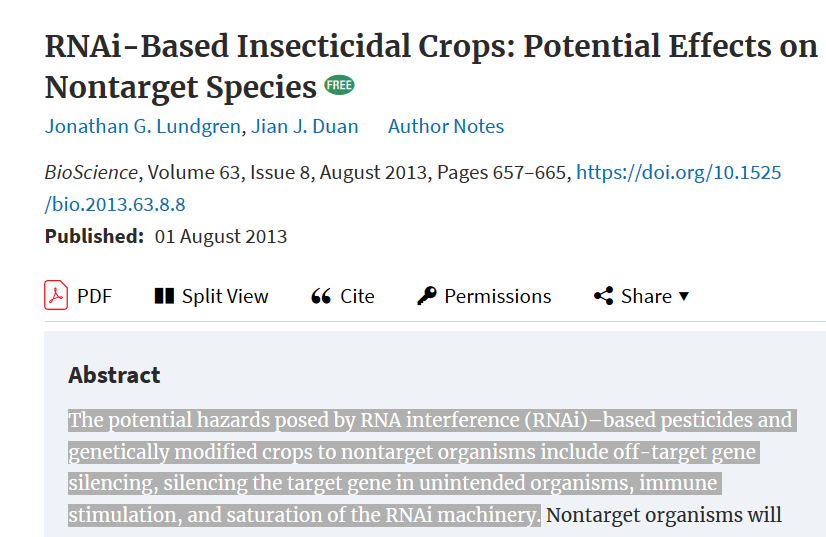
Image description
Original X alt text
JOURNAL ARTICLE RNAi-Based Insecticidal Crops: Potential Effects on Nontarget Species Jonathan G. Lundgren, Jian J. Duan Author Notes BioScience, Volume 63, Issue 8, August 2013, Pages 657–665, doi.org/10.1525/bio.2013.63.8.8 Published: 01 August 2013 pdfPDF Split View Cite Permissions Icon Permissions Share Icon Share Abstract The potential hazards posed by RNA interference (RNAi)–based pesticides and genetically modified crops to nontarget organisms include off-target gene silencing, silencing the target gene in unintended organisms, immune stimulation, and saturation of the RNAi machinery.
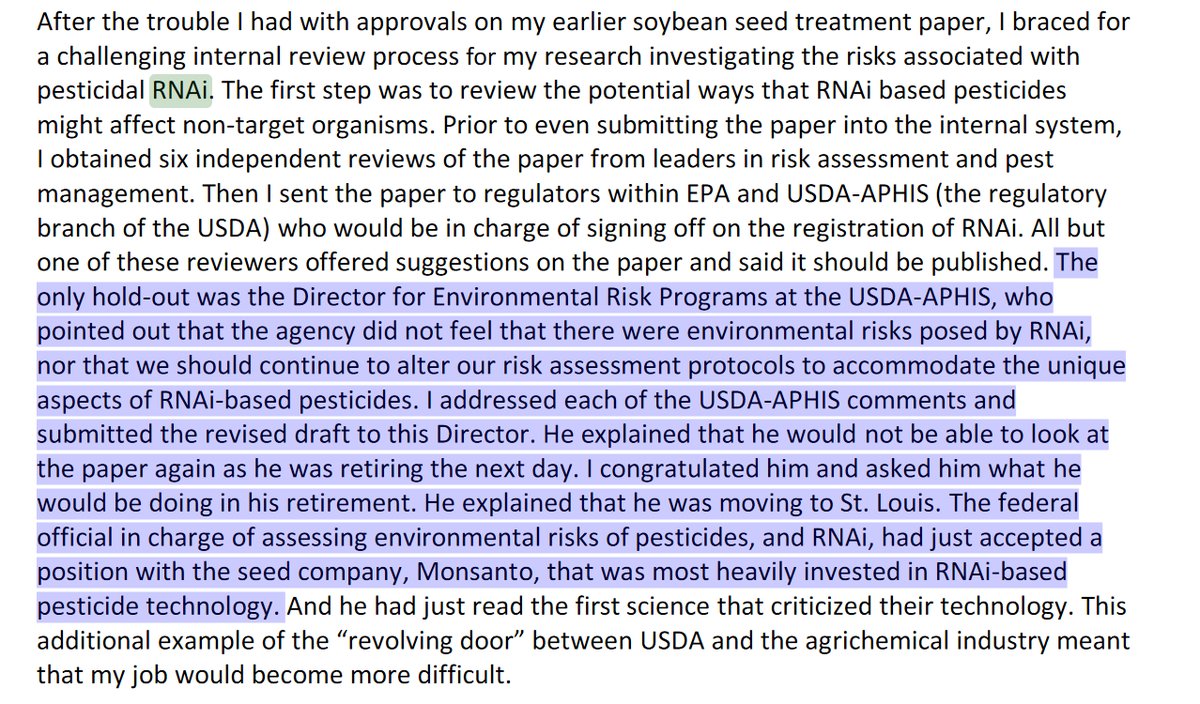
Image description
Original X alt text
Excerpts from paper linked to in tweet: Research Suppression at USDA and Stagnation of Agricultural Science Dr. Jonathan Lundgren Former USDA entomologist ...The only hold-out was the Director for Environmental Risk Programs at the USDA-APHIS, who pointed out that the agency did not feel that there were environmental risks posed by RNAi, nor that we should continue to alter our risk assessment protocols to accommodate the unique aspects of RNAi-based pesticides. I addressed each of the USDA-APHIS comments and submitted the revised draft to this Director. He explained that he would not be able to look at the paper again as he was retiring the next day. I congratulated him and asked him what he would be doing in his retirement. He explained that he was moving to St. Louis. The federal official in charge of assessing environmental risks of pesticides, and RNAi, had just accepted a position with the seed company, Monsanto, that was most heavily invested in RNAi-b...
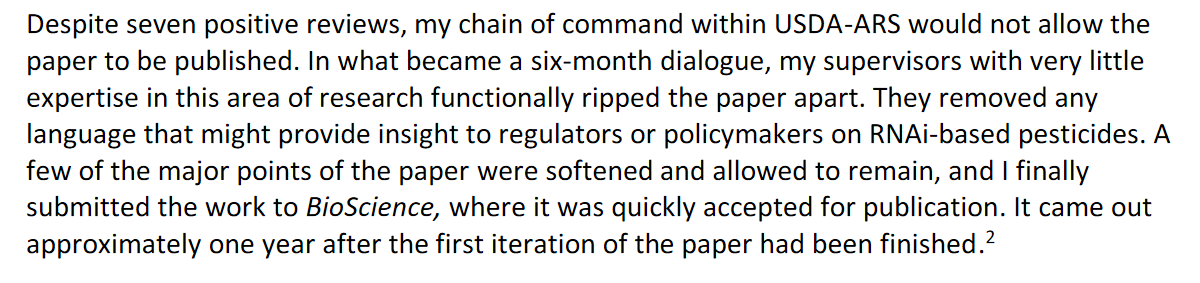
Image description
Original X alt text
Despite seven positive reviews, my chain of command within USDA-ARS would not allow the paper to be published. In what became a six-month dialogue, my supervisors with very little expertise in this area of research functionally ripped the paper apart. They removed any language that might provide insight to regulators or policymakers on RNAi-based pesticides. A few of the major points of the paper were softened and allowed to remain, and I finally submitted the work to BioScience, where it was quickly accepted for publication. It came out approximately one year after the first iteration of the paper had been finished.
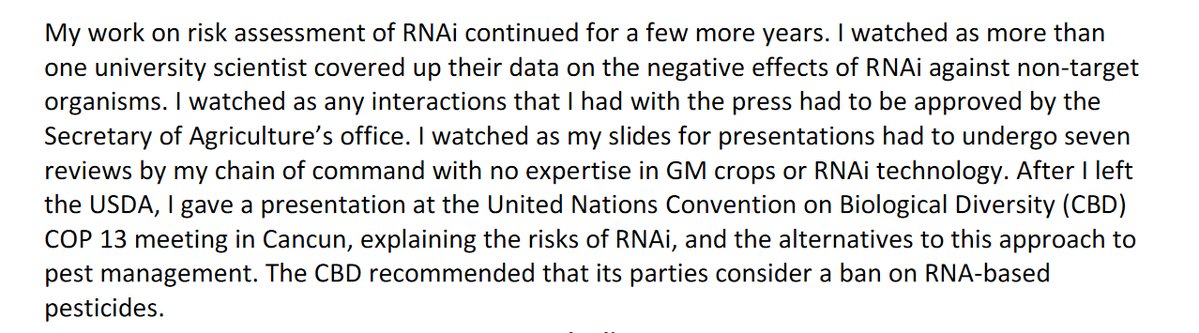
Image description
Original X alt text
My work on risk assessment of RNAi continued for a few more years. I watched as more than one university scientist covered up their data on the negative effects of RNAi against non-target organisms. I watched as any interactions that I had with the press had to be approved by the Secretary of Agriculture’s office. I watched as my slides for presentations had to undergo seven reviews by my chain of command with no expertise in GM crops or RNAi technology. After I left the USDA, I gave a presentation at the United Nations Convention on Biological Diversity (CBD) COP 13 meeting in Cancun, explaining the risks of RNAi, and the alternatives to this approach to pest management. The CBD recommended that its parties consider a ban on RNA-based pesticides.