
@AimeTim 5/ To the degree we seek inclusion and compensation with the deep ecology of landscape and all that lives, we align our vision, understanding and choices to a 'genius of place', crossing the bridge between what we can accomplish alone, and that which requires help from beyond us.
Image description
Original X alt text
About the nature of the now in the ‘here and now' - its teleology included - we are awash in counsel. About the nature of the here, a good deal less so. The oversight is not at all surprising. Hardly anyone seems to understand Marshall McLuhan's point that a medium is not a neutral conduit of transmission that has little or no impact on the content of communication. One glance at the global reach of all major schools of thought devoted to making sense of the pulse of existence - whether scientific, religious or otherwise - clearly reveals a style of thinking that is inherently portable, a medium available to communities of recognition everywhere. This is the point. What of that part of the sum of psychological and material reality which simply isn't portable? What, for example, of gnosis utterly inseparable from a slow, sustained experience of a particularized habitat?
Image description
Original X alt text
When earth-attentive cultures assert that ‘wisdom sits in places’, they are claiming that an experience of the world and existence as we may fully participate in it, is not only sustained by an attunement to a particularized locale, but is specific to that place, too. Root and branch are in dynamic interplay in a single helix of presence. This begs the question: if wisdom indeed sits in places, are ‘wisdom traditions' estranged from a sense-of-place but half-wise? Putting flesh on the word, if the supreme personal destiny which awaits us balances the path inwards with the path outwards, may we not safely deduce that where we are called to live the illuminated life matters wholeheartedly? What implications arise from enlarging our understanding of individual and communal experience in this light? And what, potentially, is the shape of a Covenant in which the human community embraces a dynamic, reciprocal relationship with the habitat of which we are an integral part?
@RizomaSchool @LwrWrl 1/ Not so much alternative, as Real refinement. 'It is not enough to aim, one must hit," as the Italian proverb goes. "We get connected when we act connected." What is it to _live_ interdependence? To make the Word flesh?
Image description
Original X alt text
Where might such a commitment begin? We find hints perhaps in the original, root etymology of the word ecology deriving from the Greek, oikos, meaning not ‘earth’ but ‘home’. The distinction is crucial, not least because the semantic drift appears to mirror an actual cultural point of departure and, now, return, suggesting that a refined ecological sensibility is not a function of a generic ‘earth science’, nor is it to be found in an amorphous ‘environmentalism’ devoid of a sense of belonging which typifies an intellectual love of the earth without feeling an emotional connection: rather, it is unearthed in the deeply-felt, intensely personalized, particularized intimacy of individual home-making. “First Nations spiritual life is completely tied to territory, to their home places.” For indigenous peoples, an experience of ‘home’ is indistinguishable from a fully-engaged ecological conscience - what anthropologists identify as an ‘ethic of reciprocity’ and ‘contingent proprietorship’.
Image description
Original X alt text
Simply put, where an ‘ethic of reciprocity’ acknowledges the mutual dependence of everything within an ecological system with the result that humans are seen as occupying a complementary as distinct from dominant role, the practice of ‘contingent proprietorship’ embodies this kincentric worldview within formalized social and ceremonial structures. For example, in so far as indigenous people did ‘own’ land in the Pacific Northwest, ownership was not perceived in the European legal sense of land ownership. Rather, a home territory’s most productive sites were identified with families or individual owners who had the right to harvest and to control the harvest of other people there. Crucially, however, such rights came with a binding obligation to tend to the needs of the clan or community by sharing with them, and to look after the land’s interest and the interests of future generations of people and other life forms...
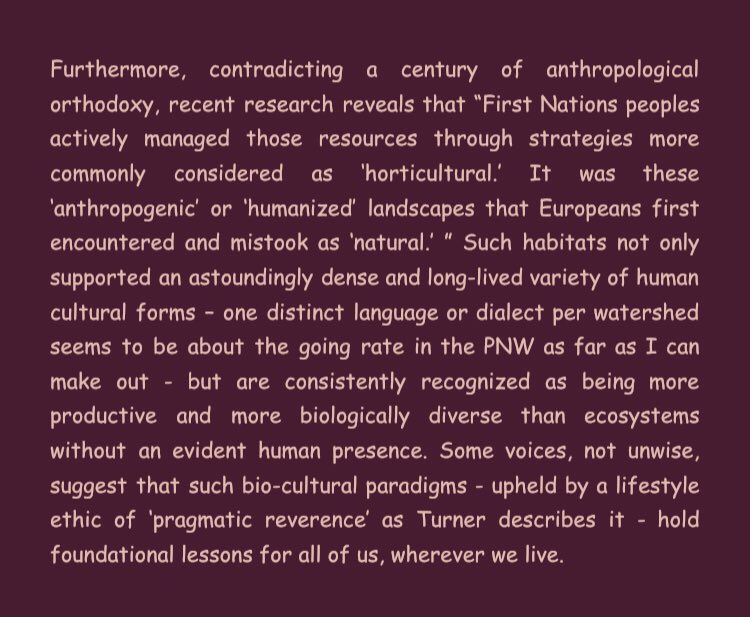
Image description
Original X alt text
Furthermore, contradicting a century of anthropological orthodoxy, recent research reveals that “First Nations peoples actively managed those resources through strategies more commonly considered as ‘horticultural.’ It was these ‘anthropogenic’ or ‘humanized’ landscapes that Europeans first encountered and mistook as ‘natural.’ ” Such habitats not only supported an astoundingly dense and long-lived variety of human cultural forms – one distinct language or dialect per watershed seems to be about the going rate in the PNW as far as I can make out - but are consistently recognized as being more productive and more biologically diverse than ecosystems without an evident human presence. Some voices, not unwise, suggest that such bio-cultural paradigms - upheld by a lifestyle ethic of ‘pragmatic reverence’ as Turner describes it - hold foundational lessons for all of us, wherever we live.