
@Eirikvi "And you are not the guide of the blind out of their error; you cannot make anyone hear but those who believe in our signs and have submitted." - 30:53 Quran. "And we never sent a warner to a community but its affluent members say, ‘We reject what you were sent with.’ ” Q 34:34.
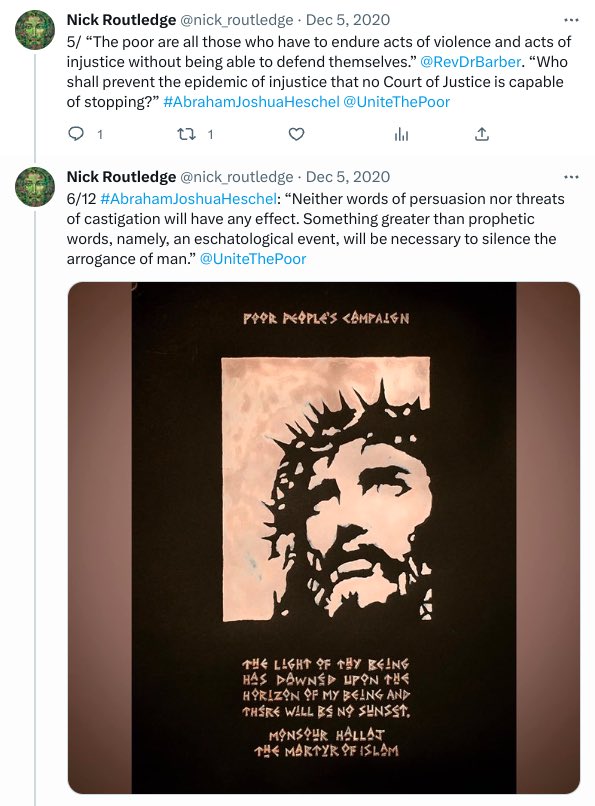
Image description
Original X alt text
Two-tweet excerpt from the thread, here: 5/ “The poor are all those who have to endure acts of violence and acts of injustice without being able to defend themselves.”@RevDrBarber. “Who shall prevent the epidemic of injustice that no Court of Justice is capable of stopping?”#AbrahamJoshuaHeschel@UniteThePoor1 @nick_routledge 6/12 #AbrahamJoshuaHeschel: “Neither words of persuasion nor threats of castigation will have any effect. Something greater than prophetic words, namely, an eschatological event, will be necessary to silence the arrogance of man.”@UniteThePoor Painted image of the head of Jesus crucified with calligrapy: Poor People's Campaign The light of thy being has dawned upon the horizon of my being and there will be no sunset. Monsour Hallaj The Martyr of Islam
@jesuits_ireland @Pontifex 4/ Our present modernity can be characterized by its endless deferral of judgment, “a secularized parody of the Church’s incessant deferral of the last judgment” (Agamben), an institution that can only preserve its own existence by endlessly postponing the judgment it announces.
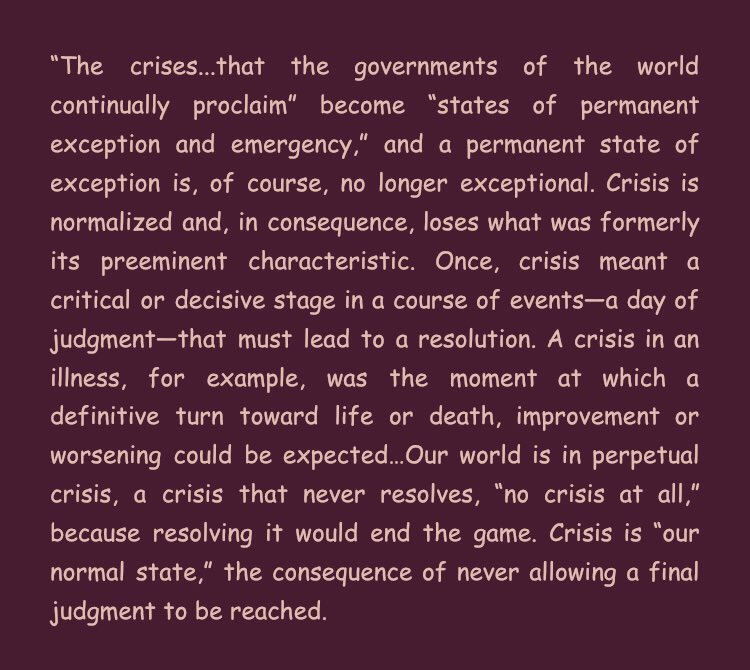
Image description
Original X alt text
“The crises...that the governments of the world continually proclaim” become “states of permanent exception and emergency,” and a permanent state of exception is, of course, no longer exceptional. Crisis is normalized and, in consequence, loses what was formerly its preeminent characteristic. Once, crisis meant a critical or decisive stage in a course of events—a day of judgment—that must lead to a resolution. A crisis in an illness, for example, was the moment at which a definitive turn toward life or death, improvement or worsening could be expected…Our world is in perpetual crisis, a crisis that never resolves, “no crisis at all,” because resolving it would end the game. Crisis is “our normal state,” the consequence of never allowing a final judgment to be reached.
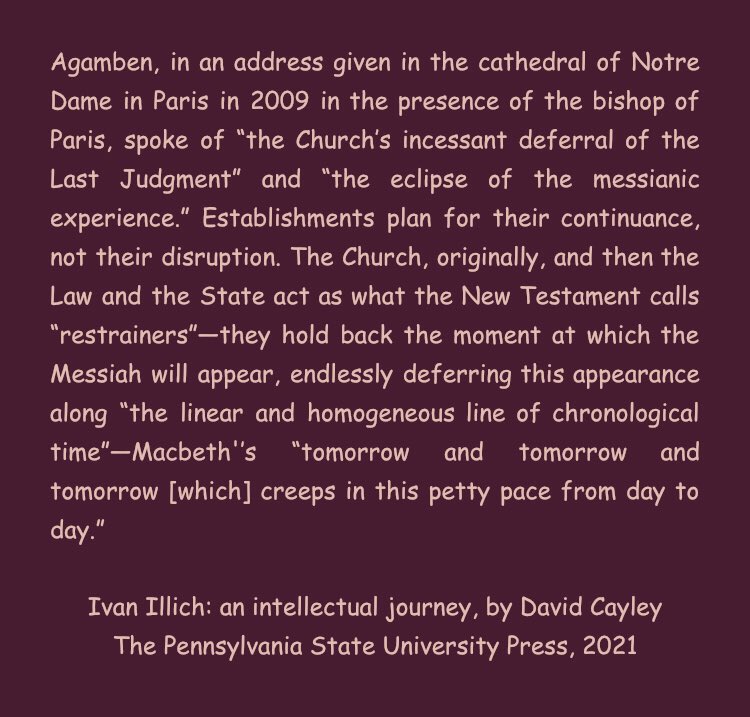
Image description
Original X alt text
Agamben, in an address given in the cathedral of Notre Dame in Paris in 2009 in the presence of the bishop of Paris, spoke of “the Church’s incessant deferral of the Last Judgment” and “the eclipse of the messianic experience.” Establishments plan for their continuance, not their disruption. The Church, originally, and then the Law and the State act as what the New Testament calls “restrainers”—they hold back the moment at which the Messiah will appear, endlessly deferring this appearance along “the linear and homogeneous line of chronological time”—Macbeth'’s “tomorrow and tomorrow and tomorrow [which] creeps in this petty pace from day to day.” Ivan Illich: an intellectual journey, by David Cayley The Pennsylvania State University Press, 2021

Image description
Original X alt text
Portrait of Giorgio Agamben
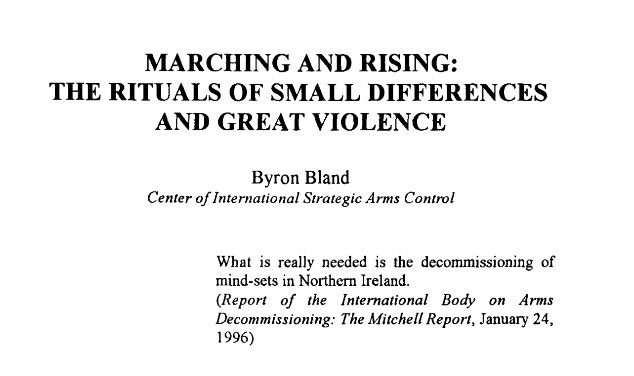
Image description
Original X alt text
Frontspiece to a paper by Byron Bland of the Center of Strategic Arms Control titled, 'Marching and Rising: The Rituals of Small Differences and Great Violence.' With the quotation subhead: "What is really needed is the decommissioning of mind-sets in Northern Ireland." (Report of the International Body in Arms Decommissioning: The Mitchell Report, January 24, 1996)