
Nick Routledge@AgrarianSharing

A brief video meditation describing the surprisingly impactful, eco-cultural leverage afforded by small-scale, community-based, agro-biodiversity nursery work. This, as our volunteers prepare for a major wave of co-ordinated, pan-bioregional seed increases.

Quoted or linked post

Nick Routledge@nick_routledge · 27 Jun 2023

end/ What is to be done? Don't look to your jailers. In the PNW, the @agrariansharing Seed Increase Initiative is taking practical steps to bring a set of values to food system stewardship which are, not unrelatedly, naturally in accord with co-evolutionary realpolitik. @GMWatch
"Crop varieties incorporate the values of their creators. When you grow varieties bred by others, you propagate their values along with their varieties. Today's professional plant breeders - university and corporate - are breeding plants to facilitate and serve the modern megafarm agribusiness pattern. Bred into the varieties are the values of their creators - that more is always better, that monocultures are best, and that pollution, biodiversity, and sustainability don't matter.

"It is time for new patterns - new patterns for agriculture, and new patterns for plant breeding. It's time for the rising up of a new generation of plant breeders out of the soil of our farms and gardens. It is time for farmers and gardeners everywhere to take back our seeds, to rediscover seed saving, and to practice our own plant breeding. It is time to breed plants based upon an entirely different set of values.”
- Carol Deppe
Image description

Original X alt text

"Crop varieties incorporate the values of their creators. When you grow varieties bred by others, you propagate their values along with their varieties. Today's professional plant breeders - university and corporate - are breeding plants to facilitate and serve the modern megafarm agribusiness pattern. Bred into the varieties are the values of their creators - that more is always better, that monocultures are best, and that pollution, biodiversity, and sustainability don't matter. "It is time for new patterns - new patterns for agriculture, and new patterns for plant breeding. It's time for the rising up of a new generation of plant breeders out of the soil of our farms and gardens. It is time for farmers and gardeners everywhere to take back our seeds, to rediscover seed saving, and to practice our own plant breeding. It is time to breed plants based upon an entirely different set of values.” - Carol Deppe
Where efforts are indeed moving away from reliance on hybrids and toward open-pollinated seed, the consequences are proving revelatory. We are finding, for example, that the open-pollinated phenomenon naturally lends itself to stewardship activities that exist, literally, beyond the ecological reach of Big Money – as befits approaches that are small-scale, highly-localized, and inextricably related to the long term care of the larger ecologies in which they are embedded. The implications are startling. If biological realpolitik is now clearly placing the mantle of authentic cultural stewardship squarely beyond the centralizing grasp of the ancien regime, who, in your neighborhood, will now assume it? Which crop varieties hold the most promise for you and your local landscape? Where are they to be found? What, all of a sudden, is to be done?
Image description

Original X alt text

Where efforts are indeed moving away from reliance on hybrids and toward open-pollinated seed, the consequences are proving revelatory. We are finding, for example, that the open-pollinated phenomenon naturally lends itself to stewardship activities that exist, literally, beyond the ecological reach of Big Money – as befits approaches that are small-scale, highly-localized, and inextricably related to the long term care of the larger ecologies in which they are embedded. The implications are startling. If biological realpolitik is now clearly placing the mantle of authentic cultural stewardship squarely beyond the centralizing grasp of the ancien regime, who, in your neighborhood, will now assume it? Which crop varieties hold the most promise for you and your local landscape? Where are they to be found? What, all of a sudden, is to be done?

We already have commitments from experienced seed growers to raise Broccoli at scale. The seed? The closest thing we have in the PNW to a functional Broccoli ‘grex’ or ‘landrace’. This legendary breeding population was first assembled by OSU’s Jim Myers in 1997 and has evolved extensively in the decades since - at the hands of OSU plant breeders and others. Indeed, ‘Solstice’, the highly regarded cultivar developed by Jonathan Spero, an Oregon-based pillar of the independent, organic plant breeding movement was born of this population. 'Umpqua', another OP Broccoli standard familiar to many of us in the PNW, and developed by Tim Peters - also an Oregon-based, independent plant breeder - emerged from the Broccoli breeding population created by Jim' Myers' predecessor, Jim Baggett. Clearly, we enjoy a local tradition of freelance, grassroots plant stewards standing upon the shoulders of world-class, public-domain, scientific plant-breeders. The shoulders of giants, no less.
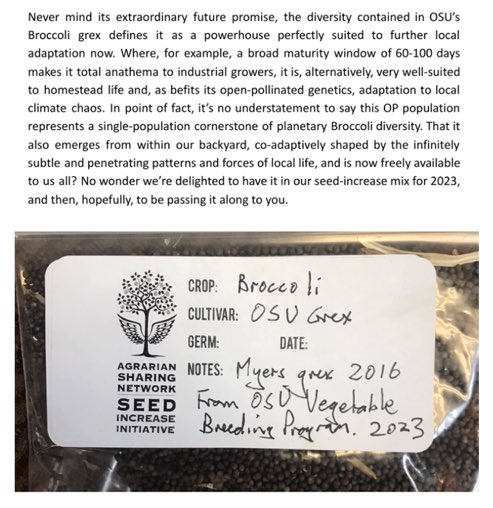
Image description

Original X alt text

We already have commitments from experienced seed growers to raise Broccoli at scale. The seed? The closest thing we have in the PNW to a functional Broccoli ‘grex’ or ‘landrace’. This legendary breeding population was first assembled by OSU’s Jim Myers in 1997 and has evolved extensively in the decades since - at the hands of OSU plant breeders and others. Indeed, ‘Solstice’, the highly regarded cultivar developed by Jonathan Spero, an Oregon-based pillar of the independent, organic plant breeding movement was born of this population. 'Umpqua', another OP Broccoli standard familiar to many of us in the PNW, and developed by Tim Peters - also an Oregon-based, independent plant breeder - emerged from the Broccoli breeding population created by Jim' Myers' predecessor, Jim Baggett. Clearly, we enjoy a local tradition of freelance, grassroots plant stewards standing upon the shoulders of world-class, public-domain, scientific plant-breeders. The shoulders of giants, no less.

Never mind its extraordinary future promise, the diversity contained in OSU’s Broccoli grex defines it as a powerhouse perfectly suited to further local adaptation now. Where, for example, a broad maturity window of 60-100 days makes it total anathema to industrial growers, it is, alternatively, very well-suited to homestead life and, as befits its open-pollinated genetics, adaptation to local climate chaos. In point of fact, it’s no understatement to say this OP population represents a single-population cornerstone of planetary Broccoli diversity. That it also emerges from within our backyard, co-adaptively shaped by the infinitely subtle and penetrating patterns and forces of local life, and is now freely available to us all? No wonder we’re delighted to have it in our seed-increase mix for 2023, and then, hopefully, to be passing it along to you.

Photograph of Agrarian Sharing Network seed, labeled:
Broccoli
OSU Grex
Myers grex 2016
From OSU Vegetable Breeding Program, 2023
Image description

Original X alt text

Never mind its extraordinary future promise, the diversity contained in OSU’s Broccoli grex defines it as a powerhouse perfectly suited to further local adaptation now. Where, for example, a broad maturity window of 60-100 days makes it total anathema to industrial growers, it is, alternatively, very well-suited to homestead life and, as befits its open-pollinated genetics, adaptation to local climate chaos. In point of fact, it’s no understatement to say this OP population represents a single-population cornerstone of planetary Broccoli diversity. That it also emerges from within our backyard, co-adaptively shaped by the infinitely subtle and penetrating patterns and forces of local life, and is now freely available to us all? No wonder we’re delighted to have it in our seed-increase mix for 2023, and then, hopefully, to be passing it along to you. Photograph of Agrarian Sharing Network seed, labeled: Broccoli OSU Grex Myers grex 2016 From OSU Vegetable Breeding Program, 2023

View this post’s context →

Context in the archive

Quoted byThese days, I'm raising transplants for @AgrarianSharing seed increases out of a homestead greenhouse where nursery space is at a huge premium. Here, a folksy but proven technique for greatly reducing the resource overhead on raising tomato starts, at this point of the season.Quoted byRT @AgrarianSharing: A veteran of 25 years repeatedly endeavoring and failing to catalyze co-ordinated, community-based seed-increases, I'm treasuring a long-awaited turning of the tide. We've now placed eleven unique B. oleraceae accessions in isolated ground at population sizes ca. 125-250 plants.Quoted byRT @AgrarianSharing: A veteran of 25 years repeatedly endeavoring and failing to catalyze co-ordinated, community-based seed-increases, I'm treasuring a long-awaited turning of the tide. We've now placed eleven unique B. oleraceae accessions in isolated ground at population sizes ca. 125-250 plants.Quoted byA veteran of 25 years repeatedly endeavoring and failing to catalyze co-ordinated, community-based seed-increases, I'm treasuring a long-awaited turning of the tide. We've now placed eleven unique B. oleraceae accessions in isolated ground at population sizes ca. 125-250 plants.Quoted by@reggaj On that note, it occurs to me to ask if you have any capacity/interest in a Brassica grow out? We can get you a list and supply starts and support. We've been freely sharing world-class seed into the Applegate for years. You, of all folk, would be a great fit. @AgrarianSharing