
Nick Routledge@nick_routledge
Reply to @SophiaCycles

@SophiaCycles Indeed, an about-turn so totalizing that its planetary advent amounts to the redemption of the future from the power of history. @UniteThePoor
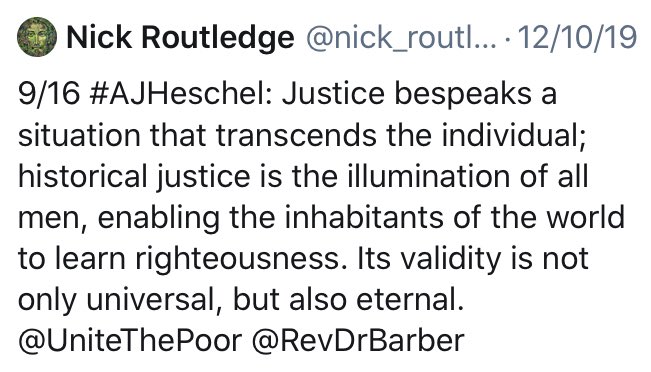
Copy of tweet:

9/16 #AJHeschel: Justice bespeaks a situation that transcends the individual; historical justice is the illumination of all men, enabling the inhabitants of the world to learn righteousness. Its validity is not only universal, but also eternal.
Image description

Original X alt text

Copy of tweet: 9/16 #AJHeschel: Justice bespeaks a situation that transcends the individual; historical justice is the illumination of all men, enabling the inhabitants of the world to learn righteousness. Its validity is not only universal, but also eternal.

Quoted or linked post

Nick Routledge@nick_routledge · 9 Sept 2022

"What is called the end of history is simply the end of temporal history and the beginning of the eternal history of life." ~ Juergen Moltmann
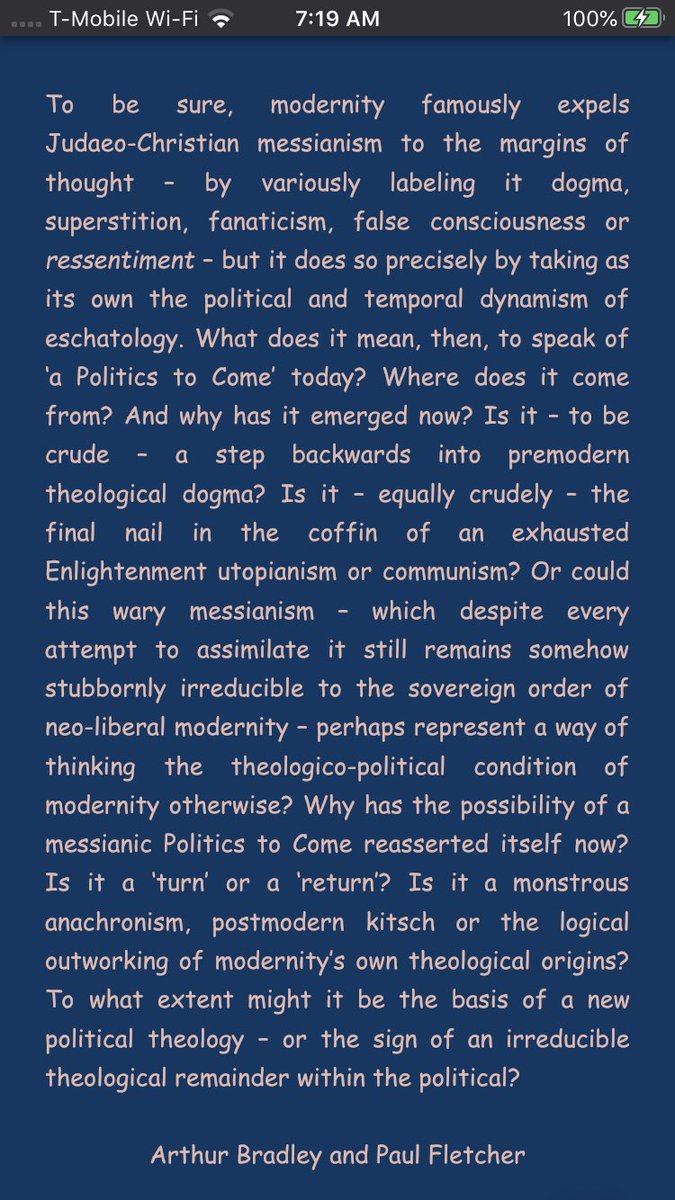
What does it mean, then, to speak of ‘a Politics to Come’ today? Where does it come from? And why has it emerged now? Is it – to be crude – a step backwards into premodern theological dogma? Is it – equally crudely – the final nail in the coffin of an exhausted Enlightenment utopianism or communism? Or could this wary messianism – which despite every attempt to assimilate it still remains somehow stubbornly irreducible to the sovereign order of neo-liberal modernity – perhaps represent a way of thinking the theologico-political condition of modernity otherwise? Why has the possibility of a messianic Politics to Come reasserted itself now? Is it a ‘turn’ or a ‘return’? Is it a monstrous anachronism, postmodern kitsch or the logical outworking of modernity’s own theological origins? To what extent might it be the basis of a new political theology – or the sign of an irreducible theological remainder within the political?

Arthur Bradley and Paul Fletcher
Image description

Original X alt text

What does it mean, then, to speak of ‘a Politics to Come’ today? Where does it come from? And why has it emerged now? Is it – to be crude – a step backwards into premodern theological dogma? Is it – equally crudely – the final nail in the coffin of an exhausted Enlightenment utopianism or communism? Or could this wary messianism – which despite every attempt to assimilate it still remains somehow stubbornly irreducible to the sovereign order of neo-liberal modernity – perhaps represent a way of thinking the theologico-political condition of modernity otherwise? Why has the possibility of a messianic Politics to Come reasserted itself now? Is it a ‘turn’ or a ‘return’? Is it a monstrous anachronism, postmodern kitsch or the logical outworking of modernity’s own theological origins? To what extent might it be the basis of a new political theology – or the sign of an irreducible theological remainder within the political? Arthur Bradley and Paul Fletcher

View this post’s context →

Context in the archive

Quoted by@MarlonMillner 2/ When asked, "Why evil?" Ramakrishna responded, "To thicken the plot." Juergen Moltmann: "That is why the history of Christ is subject to what Ernst Kasemann calls 'the eschatological proviso' and is engraved with the hallmark of eschatological anticipation."