
Nick Routledge@nick_routledge
Reply to @sssfCommunity

@sssfCommunity The world-changing teleology of His second great precept: perfecting God in the perfection of loving Another. Gibran: “When you enjoy loving your neighbor it ceases to be a virtue.” Bourgeault: "Salvation is measured by the capacity to love your neighbor as yourself."
Tweets, copied.

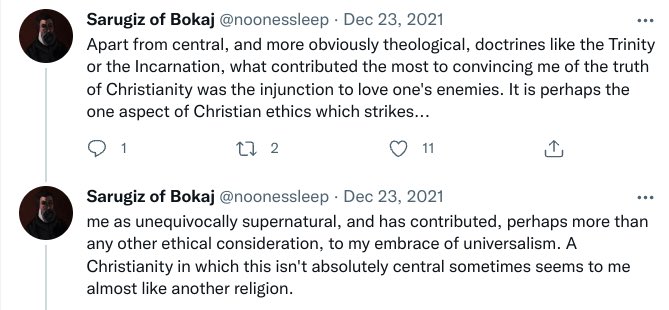
Apart from central, and more obviously theological, doctrines like the Trinity or the Incarnation, what contributed the most to convincing me of the truth of Christianity was the injunction to love one's enemies. It is perhaps the one aspect of Christian ethics which strikes...
Sarugiz of Bokaj
·
me as unequivocally supernatural, and has contributed, perhaps more than any other ethical consideration, to my embrace of universalism. A Christianity in which this isn't absolutely central sometimes seems to me almost like another religion.
Image description

Original X alt text

Tweets, copied. Apart from central, and more obviously theological, doctrines like the Trinity or the Incarnation, what contributed the most to convincing me of the truth of Christianity was the injunction to love one's enemies. It is perhaps the one aspect of Christian ethics which strikes... Sarugiz of Bokaj · me as unequivocally supernatural, and has contributed, perhaps more than any other ethical consideration, to my embrace of universalism. A Christianity in which this isn't absolutely central sometimes seems to me almost like another religion.

Quoted or linked post

Nick Routledge@nick_routledge · 23 Dec 2021

@noonessleep 1/ Beautifully stated and I couldn’t agree more. Non-retaliation, the essential pivot-point upon which the entire world returns to love, in and through us. We are one. As Yeats understood, “We make out of the quarrel with others, rhetoric, but of the quarrel with ourselves.”

View this post’s context →

Context in the archive

Quoted by@thewritertype Thank you, Paul. Metaphysically stated, I might add that "the suffering of this love is the most fruitful and most liberating power", the supernatural locus of a creative experience in which the divided self returns the entire world, as and through us, to an essential wholeness.Quoted by1/ @RichardRohrOFM "Almost two-third's of Jesus' teachings are directly or indirectly about forgiveness." Why? Did He realize forgiveness as the supernatural locus of a creative experience, in which the divided self returns the entire world, through us, to an essential wholeness?